
Preparing America for the AI Flood
Imagine a snake eating itself, consuming its own tail. This is our AI paradigm, and Big Tech's grip is just getting tighter around our necks. While AI offers exciting possibilities for solving global challenges, it also poses significant risks that extend far beyond our screens.


Three Crises with Readily-Available Solutions
Artificial Intelligence rise presents three interconnected crises that work in concert as an interlocking machinery of reality distortion. These aren't isolated problems—they reinforce each other in a dangerous cycle that we must break:
AI-driven disinformation erodes our ability to distinguish fact from fiction, weakening societal trust. Building collective resilience against reality manipulation—whether from human actors or AI systems—is now essential for a functioning society.
Research shows that only 3% of users generate one-third of all toxic content on platforms, yet this digital pollution is pushed into the feeds of billions of users every day, around the clock.


Unchecked Corporate Power
A few corporations wield immense control over our digital lives, shaping discourse and behavior with minimal accountability. We deserve solutions that empower people to make their time better spent.
Big Tech companies are exploiting data workers across the Global South while creative professionals watch their work get swallowed up without consent or compensation.
AI infrastructure affects your pocketbook - a perverse system where everyday people pay more money to burn the dirtiest fossil fuels to generate digital pollution and misinformation. American and global manufacturers are ready to build cheaper solutions to power the globe, it's time for all hands on deck.
Look no further than Memphis, Tennessee, where a supercomputer is intensifying pollution in Boxtown, a historically Black community that already experiences higher rates of asthma and cancer than any other neighborhood in the city, while extracting the city's most valuable resource—its water.
Hidden Economic and Environmental Costs
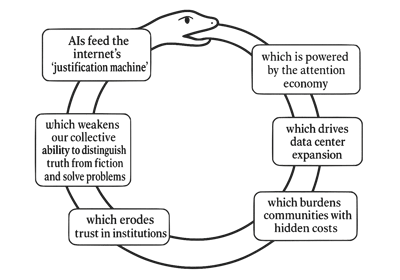


The Erosion of Shared Truth
Key Insights


Addressing Root Causes for Lasting Change
The framework targets the root causes of our challenges to build long-term resilience—strengthening communities and individuals to withstand future disruptions and thrive in the AI age.


Win-Win Strategies
The most important point: many of these solutions actually serve Silicon Valley's self-interests. Cheaper clean energy, better infrastructure, and reliable human content—all boost profits while helping American families. Innovation and the public good can coexist."
Cross-Political Appeal
The framework is designed to bridge political divides by incorporating solutions that appeal to pro-freedom, pro-consumer, pro-creator, and anti-pollution values.


"This is a virtuosic piece of writing. DeGraff smartly takes a holistic view of the interlocking challenges society is confronting in the age of AI, and he outlines the steps society should take to avoid the pitfalls and capitalize on the opportunities. These are urgent matters. We are lucky he provided us with this timely roadmap."
- Noah Giansiracusa, Associate Professor of Mathematics at Bentley University, Visiting Scholar at Harvard, and author of Robin Hood Math.


"A must read for parents, educators, policy-makers, journalists and, well, pretty much anyone who is concerned with the impact and intersection of our rapidly advancing technology on the health of individuals and society.
DeGraff’s accessible, thought-provoking piece adroitly weaves an examination of both the risks and opportunities inherent in artificial intelligence and technology, while arguing to ensure we not lose our humanity in the ever-expanding attention economy.”
- Joseph Valenzano, Dean of the College of Communication, Butler University
Even the best AI summary tools make mistakes, leaving new readers with false impressions. It's probably doing that to your work too.
Please read the version that suits your time.
Kenneth Russell DeGraff
Kenneth DeGraff spent nearly two decades on Capitol Hill, Having spent 20 years on Capitol Hill helping policymakers navigate complex issues, DeGraff has seen how hard it is for Congress to find agreement on problems and basic facts, much less solutions. Congressional leaders are often caught between acknowledging potential harm and letting AI run wild for the sake of innovation—but this is a false choice.
During his 12 years as the chief climate, technology and science advisor to House Speaker Nancy Pelosi, he played a key role in helping Congress design, enact, explain and enforce legislation, including President Biden's "Investing in America" jobs strategy. His work included contributions to landmark laws like the Inflation Reduction Act ("the most significant legislation in history to tackle the climate crisis" according to the UN), the CHIPS & Science Act, and the Infrastructure Investment and Jobs Act.
Before serving Speaker Pelosi, DeGraff was the Legislative Director and Assistant to Congressman Mike Doyle, a Policy Analyst at Consumer Reports, and a Truman Scholar from Butler University.
He was recently a member of the U.S. Foreign Policy for Clean Energy Taskforce of the Carnegie Endowment for International Peace. He wrote this paper as a Joan Shorenstein Fellow at the Shorenstein Center on Media, Politics and Public Policy at the Harvard Kennedy School of Government.
150+
20
Years of experience
Laws enacted
Machines of Truth
and Distortion
Aligning AI innovation with individual rights and sustainability.
Join the newsletter
© 2025. All rights reserved.